Aluminum Die Casting
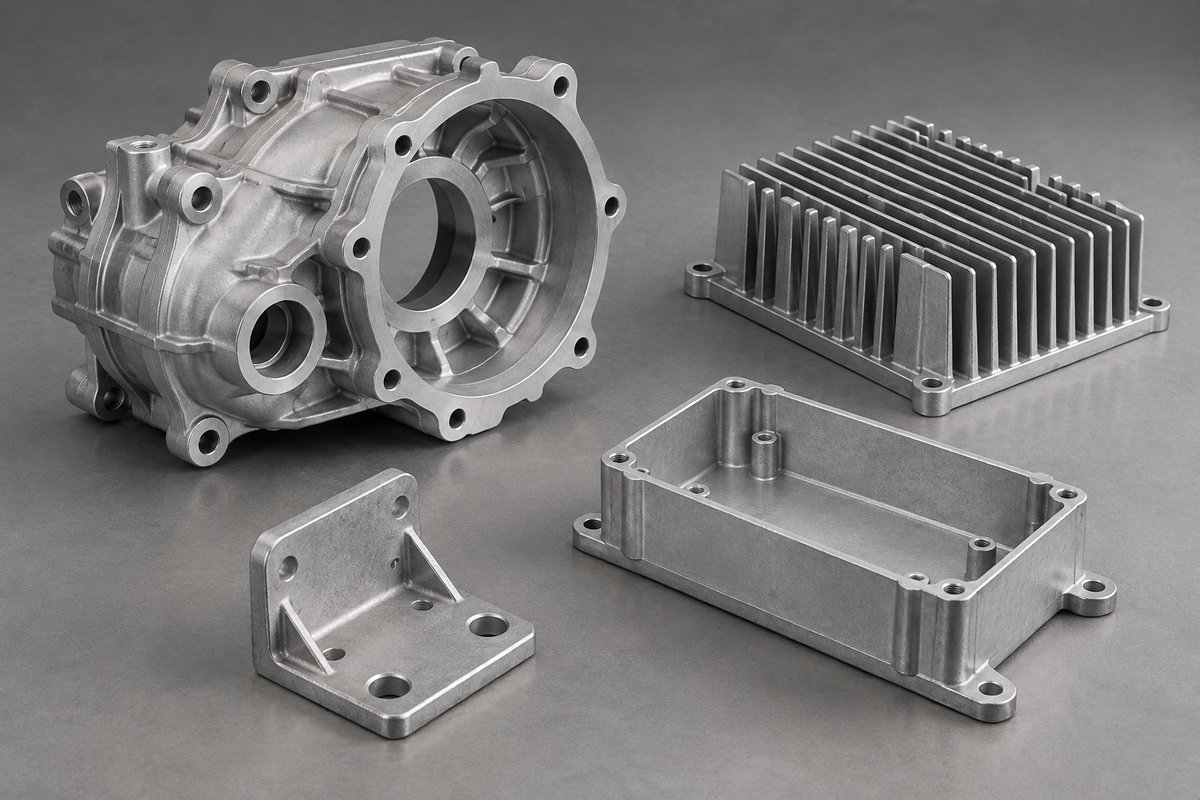
Aluminum die casting injects molten aluminum alloy into a hardened steel die at high speed and pressure. It produces light, thin-walled parts with consistent dimensions at short cycle times, which is why die cast aluminum is used for enclosures, covers, gearbox housings, heat sinks and structural brackets.
Typical die cast aluminum parts
- Electronics and control enclosures, covers and frames
- Motor and gearbox housings
- Finned heat sinks and LED lighting parts
- Brackets, arms and bases for machinery and robotics
- Automotive and powersports components (requirements confirmed per drawing and specification)
Common aluminum die casting alloys
| Alloy | Family | Characteristics |
|---|---|---|
| A380 | Al-Si-Cu | The most widely used alloy in North America; good castability, strength and machinability |
| A383 | Al-Si-Cu | Better fluidity than A380 for thin, complex parts; close to Japanese ADC12 |
| ADC12 / YL113 | Al-Si-Cu | Japanese and Chinese standard alloy, widely available in Asia |
| A360 | Al-Si-Mg | Better corrosion resistance and ductility; harder to cast |
Equivalents are approximate — composition limits differ between standards. More detail in die casting alloys: A380, ADC12 and Zamak.
Design checks before tooling
| Item | What to check |
|---|---|
| Wall thickness | Keep it as uniform as possible; heavy sections are prone to porosity and sink |
| Draft | Needed to release the part from the die; varies with wall position and depth |
| Radii | Avoid sharp corners — they hurt metal flow and die life |
| Machined surfaces | Mark which faces stay as-cast and which are machined (sealing faces, fits, threads) |
| Tolerances | As-cast tolerances follow casting standards (e.g. ISO 8062 / NADCA); tight features are usually machined |
| Porosity and leak tightness | If parts must hold pressure, agree the test method and acceptance criteria up front |
Machining and finishing
Most die castings need some machining — drilling, tapping and milling of sealing faces. Huasheng Precision is a CNC machining manufacturer, and machining of castings is done in-house or with partners depending on the drawing. Finishes include shot blasting, powder coating, wet paint, anodizing and chemical conversion coating.
→ Machining and finishing of castings
What to send for a quote
- Drawing (PDF) and 3D model (STEP)
- Alloy, or the application and environment if undecided
- Quantities: prototypes, first lot and expected annual volume
- Machining scope, finish and cosmetic requirements
- Leak testing, dimensional reports or material certificates required
- Target date and delivery location
Tooling cost depends heavily on part size, cavities, slides and complexity — see die casting tooling cost and die life.
FAQ
Can you make prototypes before tooling?
Parts can be machined from solid to check fit and function before a production die is built. Tell us the quantity and purpose and we will suggest a route.
Can aluminum die castings be welded or heat treated?
Conventional high-pressure die castings can contain entrapped gas, which may cause blistering when welded or solution heat treated. If you need either, discuss process and alloy at the design stage.
Is ADC12 the same as A380?
No. They are similar Al-Si-Cu alloys and often compared, but the silicon and copper ranges differ. ADC12 is closer to A383, and ADC10 is closer to A380. Substitutions need designer approval.